
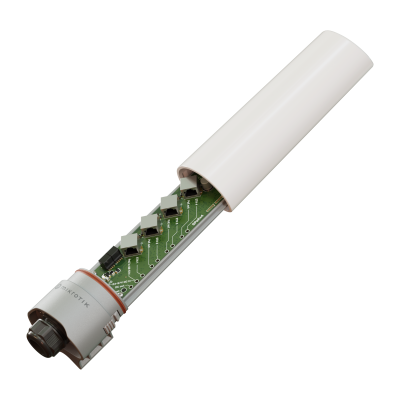


MikroTik GPeRx4 90W PoE Splitter 3-Port PoE-Out IP68
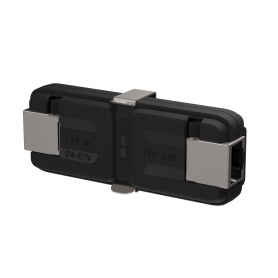
The MikroTik GPeRx4 is an IP68-rated outdoor PoE splitter — taking a single 802.3bt 90W PoE-in port and distributing it across three independent 802.3af/at PoE-out ports (Ether2–Ether4), each delivering up to 30W, with a fourth port (Ether1) as the PoE-in uplink. SwOS Lite managed with VLAN, SNMP, traffic shaping, interface monitoring, and GPEN fault detection. 802.3bt PoE-in (48–57V) plus 2-pin terminal input (24–57V), Marvell 88E6341 switch chip, 200 MHz CPU, 64 KB FLASH, 4W without attachments and 115W max, -40°C to +70°C, MTBF ~100,000 hours at 25°C. Includes hose clamp. CE, EAC, and RoHS certified.

We only offer IC Certified products. For international products, contact us.

Ship Charge Will Display As Free Until Ship Address / Location Is Provided To Calculate Ship Charge.
The MikroTik GPeRx4 answers a specific installation problem that appears repeatedly in outdoor network deployments: a network switch has a single high-power 802.3bt PoE-out port available at a distribution point — a rooftop, a pole, a building entry point, or an outdoor equipment mount — and the operator needs to power three downstream devices (cameras, access points, sensors, or other PoE-powered equipment) from that single port, without running three separate Ethernet cables from the switch to the mounting location.
The GPeRx4 takes the single 90W 802.3bt PoE input on Ether1 and splits it into three independent 802.3af/at PoE-out connections on Ether2, Ether3, and Ether4 — each port delivering up to 30W (802.3at maximum), with a total combined PoE-out current limit of 2.0 A. Three IP cameras, three access points, three IoT gateways, or any combination of 802.3af/at powered devices can be connected and powered from what was previously a single PoE port on the upstream switch. The single Ethernet cable run from the switch to the GPeRx4's mounting location carries both the upstream data and the full 90W PoE power budget — the GPeRx4 distributes both to three downstream devices at the mounting point.
The port isolation architecture is the critical operational note that must be understood before deployment. The GPeRx4 is not a traditional switch — the PoE-out ports (Ether2–Ether4) are isolated from each other and communicate only with the upstream port (Ether1). Downstream devices on Ether2, Ether3, and Ether4 can each communicate with the upstream network through Ether1, but they cannot communicate with each other through the GPeRx4. For IP camera deployments where cameras should not see each other's traffic, IoT sensor deployments where device isolation is a security requirement, and any deployment where downstream device-to-device traffic is undesirable, this isolation architecture is a direct security benefit. For deployments where downstream devices must communicate with each other, a traditional managed switch is the correct device — not the GPeRx4.
SwOS Lite management elevates the GPeRx4 above a dumb passive PoE splitter. The same Marvell 88E6341 switch chip used in the FTC21 media converter powers the GPeRx4's hardware switching and management functions — hardware-accelerated VLAN tagging, traffic shaping, and ACL processing at line rate across all four Gigabit Ethernet ports. The SwOS Lite feature set on the GPeRx4 includes:
- **Interface monitoring** — real-time port status, link speed, and traffic statistics for all four ports via the SwOS Lite web interface and SNMP
- **VLAN support** — configure VLAN tagging and port-based VLAN segmentation — assign downstream PoE devices to specific VLANs for traffic isolation and management network separation
- **Traffic shaping** — per-port bandwidth limits on downstream PoE device ports — enforce bandwidth tiers for cameras, APs, or IoT devices connected to Ether2–Ether4
- **SNMP reporting** — integrate into an existing SNMP-based NMS — port status, traffic counters, PoE device connectivity, and device health visible in the monitoring system
- **GPEN fault detection** — MikroTik's GPEN (Gigabit Passive Ethernet Network) link fault detection — monitors the upstream GPEN link on Ether1 and reports faults to the management system
The GPEN fault detection capability is specifically noted in MikroTik's product description — the GPeRx4 is designed to operate in GPEN (long-range Gigabit passive Ethernet) link architectures where the upstream Ether1 connection may traverse a long cable run or a passive GPEN extender chain. GPEN fault detection provides active monitoring of the upstream link quality — relevant for outdoor deployments where cable damage, water ingress, or connector degradation can degrade the upstream connection before it fails completely.
The dual power input architecture provides installation flexibility. The primary power input is 802.3bt PoE-in (48–57V) on Ether1 — the same cable that carries upstream data also powers the GPeRx4 and provides the PoE power budget for downstream devices. The secondary input is a 2-pin terminal (24–57V) — a direct DC power connection for installations where the upstream switch's PoE port does not have 802.3bt capability or where a separate DC power supply at the mounting point is available or preferred. The 2-pin terminal input allows the GPeRx4 to be powered independently of the PoE-in port — the upstream Ether1 connection carries data only, and the power comes from the terminal input. For installations where the upstream connection is a standard (non-PoE) Gigabit Ethernet port and a local DC power supply is available at the mounting point, the 2-pin terminal input is the correct power source.
The IP68 rating is the highest IP weatherproofing rating in this product batch — exceeding the IP55 of the NetBox 5 ax and FTC21, and the IP54 of the wAP LR8 kit. IP68 provides complete dust ingress protection and continuous submersion protection beyond the IP55 water jet standard. For outdoor deployments in exposed locations — mounting points subject to driving rain, standing water, spray, or temporary submersion during flooding events — IP68 is the maximum available weatherproofing standard for a network device in this form factor. The included hose clamp supports pipe or pole mounting in outdoor environments.
Maximum power consumption is 115W under full load with all three PoE-out ports active at maximum draw — the 802.3bt 90W input plus the 4W device overhead is consistent with the 115W figure. The 4W device consumption without attachments (no PoE-out load) is minimal — the GPeRx4 consumes negligible power when downstream PoE devices are disconnected.
The -40°C to +70°C operating temperature range and IP68 rating make the GPeRx4 deployable in any outdoor Canadian environment — including exposed pole mounts in Prairie winters, coastal maritime environments, and northern remote installations where weatherproofing and freeze-thaw resilience are hard requirements.
**Canadian outdoor deployment context:** At USD 59.00, the GPeRx4 is the lowest-cost path to powering three outdoor PoE devices from a single cable run in a Canadian outdoor installation. A rooftop installation requiring three IP cameras or three Wi-Fi APs with PoE power — previously requiring three separate Ethernet cable runs from the switch room to the roof — is reduced to a single cable run to the GPeRx4 mounting point, with three short cable drops from the GPeRx4 to each device. The cable installation cost reduction on a three-device rooftop or tower deployment is typically several times the USD 59.00 cost of the GPeRx4 itself.
Key specifications:
- **Switch chip:** Marvell 88E6341
- **OS:** SwOS Lite
- **CPU:** 200 MHz
- **Storage:** 64 KB FLASH
- **Ethernet ports:** 4× 10/100/1000 Mbps (Ether1: PoE-in uplink; Ether2–4: PoE-out)
- **PoE-in:** 802.3bt, 48–57V (Ether1)
- **PoE-out:** 802.3af/at, Ether2–Ether4, up to 30W per port
- **PoE-out current limits:** 0.7 A LV / 0.6 A HV per port, 2.0 A total combined
- **Secondary power input:** 2-pin terminal, 24–57V
- **Max power consumption:** 115W (with attachments), 4W (without)
- **Port isolation:** Ether2–4 isolated from each other — communicate with Ether1 only
- **Management:** SwOS Lite — interface monitoring, VLAN, traffic shaping, SNMP, GPEN fault detection
- **Cooling:** Passive
- **IP rating:** IP68
- **Operating temperature:** -40°C to +70°C
- **MTBF:** ~100,000 hours at 25°C
- **Certifications:** CE, EAC, RoHS — no FCC, no IC published
- **Included:** Hose clamp (1)
- **Product code:** GPER14i
- **Suggested price:** USD 59.00
Note: Port isolation — Ether2, Ether3, and Ether4 are isolated from each other; they communicate only with Ether1. This is not a traditional Layer 2 switch. For downstream device-to-device communication, a managed switch is required. 802.3bt PoE source required for full 90W input budget — confirm upstream switch PoE-out capability before deployment.

- Product code
- GPER14i
- CPU
- 200 MHz
- Switch chip model
- 88E6341
- Operating System
- SwOS Lite
- Storage size
- 16 KB, flash
- Number of DC inputs
- 2 (PoE-In, 2-pin terminal)
- PoE in
- 802.3 bt
- PoE in input Voltage
- 48-57 V
- PoE out
- 802.3af/at Ether2-Ether4
- Max out per port output - input (less than 30 V)
- 0.7 A
- Max out per port output (input more than 30 V)
- 0.6 A
- Max total out (A)
- 2.0 A
- Dimensions
- 281 x 76 x 70 mm
- 2-pin terminal input Voltage
- 24-57 V
- Operating Temperature
- -40°C to +70°C
- Certification
- IP68
- Number of 1G Ethernet ports
- 4

Related Posts


GPEN technology offers ISPs and WISPs a faster, lower-cost alternative to GPON. With reverse PoE, 10G fiber uplinks, and scalable MikroTik routing, providers can deploy reliable network infrastructure with reduced capital investment and long-term operational efficiency.