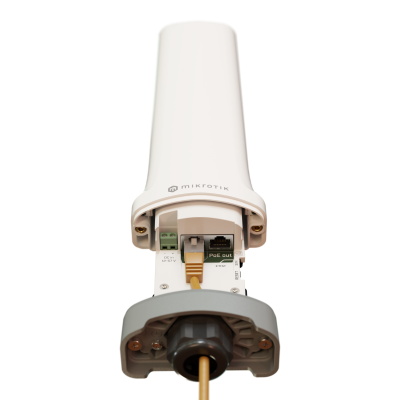


MikroTik CME Gateway CAT-M LTE IoT GPS IP66 ROS v7
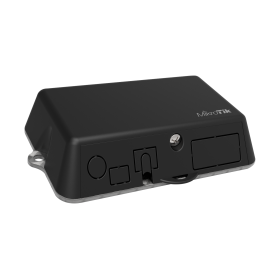
The MikroTik CME Gateway (CME22-2n-BG77) is a rugged outdoor CAT-M narrowband LTE IoT gateway — single-core MIPSBE QCA9531 at 650 MHz, 64 MB RAM, 16 MB FLASH, RouterOS v7 License 4, built-in CAT-M narrowband LTE modem (Nano SIM), built-in GPS, single-chain 802.11b/g/n 2.4 GHz Wi-Fi 4 (150 Mbps, 2 dBi) for local management via MikroTik smartphone app, 2× 10/100 Ethernet (Ether1: 802.3af/at PoE-in 18–57V; Ether2: passive PoE-out up to 57V 600 mA), 2-pin DC terminal 12–57V, 31W max consumption, IP66, -40°C to +70°C, MTBF ~100,000 hours at 25°C. CE, FCC, IC, EAC, RoHS certified. Includes 48V 0.95A power adapter, Gigabit PoE injector, two metal rings.

We only offer IC Certified products. For international products, contact us.

Ship Charge Will Display As Free Until Ship Address / Location Is Provided To Calculate Ship Charge.
The MikroTik CME Gateway is a purpose-built CAT-M narrowband LTE IoT gateway — a device designed for the specific and growing deployment scenario where a legacy wired Ethernet device needs mobile network connectivity, but full-bandwidth LTE or 5G is unnecessary, and narrowband CAT-M coverage and cost are the correct tradeoffs. Electricity meters, water meters, environmental sensors, agricultural monitoring equipment, industrial control devices, and remote telemetry units are all examples of devices that generate small, periodic data payloads — device status, meter readings, sensor values — that do not require broadband mobile data but do require reliable, low-cost, wide-area wireless connectivity. The CME Gateway's CAT-M modem delivers exactly that.
CAT-M (LTE-M, Cat-M1) is a 3GPP-standardised narrowband IoT radio access technology designed for low-bandwidth, low-power, wide-area machine-to-machine (M2M) and IoT applications. CAT-M operates in licensed LTE spectrum — it coexists with standard LTE on the same carrier infrastructure and benefits from LTE's wide geographic coverage and carrier-grade reliability. Compared to standard LTE Category 4 or above, CAT-M offers:
- **Significantly lower data plan cost:** CAT-M data plans are priced for IoT data volumes — kilobytes to megabytes per month, not gigabytes. For a deployment where each gateway sends a meter reading or sensor value every hour, CAT-M data plan costs are a fraction of standard LTE plan costs.
- **Deeper building and indoor penetration:** CAT-M uses narrowband signal processing techniques that provide up to 20 dB better signal penetration than standard LTE — reaching devices in basements, utility vaults, agricultural structures, and other locations where standard LTE signal is weak or absent.
- **Extended device range:** The improved link budget of CAT-M allows the gateway to connect to carrier base stations at greater distances than standard LTE, useful for rural, agricultural, and remote site deployments.
- **Low modem power consumption:** CAT-M modems consume significantly less power than standard LTE modems, enabling battery-operated or energy-harvesting deployments where continuous modem operation on standard LTE would drain a battery in hours rather than weeks.
The CME Gateway brings RouterOS v7 to the CAT-M IoT gateway category — a meaningful operational advantage over proprietary IoT gateway firmware. RouterOS v7 on the CME Gateway provides the full RouterOS scripting environment (via RouterOS scripts), allowing operators to:
- **Schedule data collection and transmission:** RouterOS scripts can poll a connected Ethernet device at defined intervals, collect data via Modbus TCP, SNMP, HTTP, or other protocols, format it, and transmit it over the CAT-M connection to a central server or cloud platform.
- **Configure VPN tunnels over CAT-M:** RouterOS supports WireGuard, IPsec, L2TP, and PPTP over any WAN interface including the CAT-M modem — the CME Gateway can establish a secure VPN tunnel from the remote IoT site back to a central RouterOS infrastructure over the narrowband LTE connection, providing secure remote access to the connected Ethernet device.
- **Implement firewall and NAT:** RouterOS firewall rules protect the connected downstream Ethernet device from unsolicited inbound traffic arriving over the CAT-M public IP — a meaningful security capability for industrial devices without native network security features.
- **Use the GPS data in scripts:** The built-in GPS receiver's location data is accessible within RouterOS scripting — operators can collect GPS coordinates at defined intervals and transmit them to a central server, building a location history for mobile or semi-mobile assets (agricultural equipment, utility vehicles, portable monitoring units) without external GPS tracking hardware.
The GPS capability is a hardware bonus that expands the CME Gateway's use case beyond static IoT deployments. For a farming equipment deployment where the CME Gateway is mounted on a tractor or harvester, hourly GPS location logging via RouterOS script creates an operational record of equipment movement and field coverage. For a remote monitoring unit deployed on a utility vehicle or portable generator, GPS location data confirms the unit's current location for field service scheduling. The GPS data is available via RouterOS scripting — operators familiar with RouterOS scripting can access it immediately; those unfamiliar should review the MikroTik RouterOS scripting documentation.
The single-chain 2.4 GHz Wi-Fi 4 (802.11b/g/n, 150 Mbps, 2 dBi) is included specifically for local management via the MikroTik smartphone app — not for general Wi-Fi access point function. The MikroTik smartphone app (iOS and Android) connects to the CME Gateway's Wi-Fi management interface and provides a simplified configuration UI for operators who do not use Winbox or the RouterOS web interface. For a field technician deploying CME Gateways at remote sites, the smartphone app over Wi-Fi is the fastest and most accessible initial configuration method.
Ether2's passive PoE-out (up to 57V, 600 mA, 0.6A total) allows the CME Gateway to power a co-located downstream Ethernet device directly from its PoE-out port — a compact sensor, a serial-to-Ethernet converter, a compact IP camera, or any device accepting passive PoE input at the appropriate voltage. The passive PoE-out voltage mirrors the input voltage — if the CME Gateway is powered by 48V PoE-in, the Ether2 passive PoE-out is 48V. This is a critical operational note: passive PoE-out mirrors input voltage rather than a fixed regulated output — confirm the downstream device's acceptable PoE input voltage range before connecting it to Ether2.
The IP66 rating and -40°C to +70°C operating temperature make the CME Gateway one of the most environmentally robust devices in this product batch. IP66's dust-tight and powerful water jet protection covers the full range of outdoor Canadian installation environments — agricultural fields, utility vaults, industrial facilities, rooftop equipment mounts, and unheated equipment enclosures in Canadian winter conditions. At -40°C lower limit, the CME Gateway matches the cold-temperature specification of MikroTik's most robust outdoor devices, making it suitable for year-round outdoor deployment across all Canadian climate zones without enclosure heating.
**Canadian market note — IC certification confirmed:** The CME Gateway is certified CE, FCC, IC, EAC, and RoHS — IC (ISED) certification is confirmed. This is one of the few MikroTik wireless devices in this product batch with explicit IC certification published on the product page. The CME Gateway can be listed and sold for Canadian wireless operation without an IC certification advisory. Confirm the specific IC certification number from the brochure or MikroTik's regulatory documentation for listing on the product page.
**5-year software support guarantee:** RouterOS v7 software updates are provided free for the life of the product or a minimum of 5 years from date of purchase — confirmed on the product page.
Key specifications:
- **Product code:** CME22-2n-BG77
- **Architecture:** MIPSBE
- **CPU:** QCA9531, single-core, 650 MHz
- **Switch chip:** QCA9531
- **RAM:** 64 MB
- **Storage:** 16 MB FLASH
- **OS:** RouterOS v7, License 4
- **LTE modem:** CAT-M narrowband LTE (built-in)
- **SIM slot:** 1× Nano SIM
- **GPS:** Built-in
- **Wi-Fi 2.4 GHz:** 802.11b/g/n, Wi-Fi 4, 1-chain, 150 Mbps max, 2 dBi, QCA9531
- **Ethernet:** 2× 10/100 Mbps (Ether1: 802.3af/at PoE-in; Ether2: passive PoE-out)
- **PoE-in:** 802.3af/at, 18–57V (Ether1)
- **DC terminal input:** 12–57V (2-pin)
- **PoE-out (Ether2):** Passive PoE, up to 57V, 600 mA LV / 450 mA HV, 0.6A total
- **Max power consumption:** 31W
- **Max power without attachments:** 6W
- **Cooling:** Passive
- **IP rating:** IP66
- **Operating temperature:** -40°C to +70°C
- **MTBF:** ~100,000 hours at 25°C
- **Certifications:** CE, FCC, IC, EAC, RoHS — IC confirmed
- **Included:** 48V 0.95A power adapter, Gigabit PoE injector, two metal rings

- Product code
- CME22-2n-BG77
- CPU
- QCA9531
- CPU core count
- 1
- CPU nominal frequency
- 650 MHz
- Architecture
- MIPSBE
- Size of RAM
- 64M
- Storage type
- FLASH
- Wireless 2.4 GHz standards
- 802.11b/g/n
- Antenna gain dBi for 2.4 GHz
- 2
- Operating System
- RouterOS
- RouterOS License
- L4
- Max Power consumption
- 31 W
- MTBF
- Approximately 100'000 hours at 25C
- Tested ambient temperature
- -40°C to 70°C
- Number of DC inputs
- 3 (MicroUSB, DC jack, PoE-IN)
- DC jack input Voltage
- 12-57 V
- Max power consumption without attachments
- 6 W
- PoE in
- 802.3af/at
- PoE in input Voltage
- 18-57 V
- PoE out
- Ether2
Passive PoE up to 57V - 10/100 Ethernet ports
- 2
- Number of SIM slots
- 1 Modem (Nano SIM)
- Wireless 2.4 GHz Max data rate
- 150 Mbit/s
- Wireless 2.4 GHz number of chains
- 1
- Wireless 2.4 GHz chip model
- QCA9531
- Wireless 2.4 GHz generation
- Wi-Fi 4
- Certification
- CE, FCC, IC, EAC, ROHS