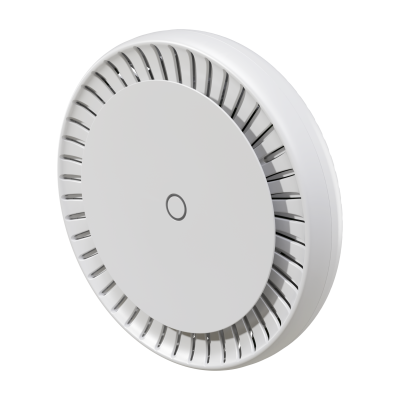


MikroTik cAP ax AX1800 Dual-Band Wi-Fi 6 Ceiling AP
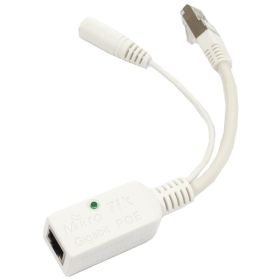
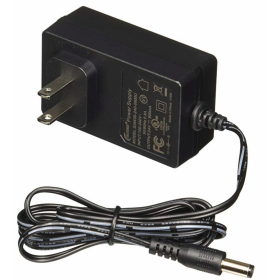
The MikroTik cAP ax (cAPGi-5HaxD2HaxD) is the Wi-Fi 6 generation of MikroTik's best-selling ceiling access point — dual-band AX1800, 2.4 GHz 802.11b/g/n/ax 2-chain 574 Mbps 6 dBi (QCN-5022) + 5 GHz 802.11a/n/ac/ax 2-chain 1,200 Mbps 5.5 dBi (QCN-5052), IPQ-6010 quad-core ARM64 at 864–1,800 MHz (auto), IPQ-6010 integrated switch, 1 GB RAM, 128 MB NAND, RouterOS v7 License 4, 2× Gigabit Ethernet (Ether1: 802.3af/at PoE-in 18–57V; Ether2: passive PoE-out up to 57V), DC jack 18–57V, 36W max consumption, passive cooling, IP20, -40°C to +70°C, MTBF ~200,000 hours at 25°C. CE, FCC, IC, EAC, RoHS certified. Includes 48V 0.95A power adapter, Gigabit PoE injector, K-81 fastening set, cAP ax ceiling bracket, cAP ax ceiling mount.

We only offer IC Certified products. For international products, contact us.

Ship Charge Will Display As Free Until Ship Address / Location Is Provided To Calculate Ship Charge.
The MikroTik cAP ax is the successor to MikroTik's best-selling cAP ac ceiling access point — and the upgrade is substantial. The cAP ax moves from dual-core MIPS to quad-core ARM64, from 128 MB to 1 GB RAM, from Wi-Fi 5 to Wi-Fi 6 AX1800, and from the original CAPsMAN to RouterOS v7's wifiwave2 CAPsMAN — all in the same ceiling-flush form factor and at a price point that makes per-room and per-zone ceiling AP deployments economically viable at scale.
**The ceiling form factor — why it matters in office and hospitality deployments**
The cAP ax's defining physical characteristic is not its radio — it is its mounting position. A ceiling-mounted AP sits above every obstacle in the room: above the desk dividers, above the metal filing cabinets, above the tinted glass partitions, above the TVs and monitors, above the people. Every 2.4 GHz and 5 GHz client in the room has a direct line-of-sight path — or near-line-of-sight — to the AP above them. Wall-mounted or desk APs share the floor level with obstacles; ceiling APs do not.
MikroTik's own product description is specific about what blocks Wi-Fi signals in office and hospitality environments: "mirrors, tinted glass, TVs, metal file cabinets." These are precisely the obstacles that make wall-mounted APs underperform in open-plan offices, hotel corridors, and retail floors. The cAP ax's ceiling mount rises above all of them.
The second benefit MikroTik explicitly highlights is visual discretion: "cAP ax remains hidden in plain sight, attracting less unwanted attention than a smoke sensor." A ceiling-flush white circular AP at 2.5–3 metres height is indistinguishable from a smoke detector or sprinkler head to a casual observer. In hotels, retail stores, restaurant dining rooms, and corporate offices where network hardware aesthetics are a facilities management concern, the cAP ax disappears into the ceiling. The included cAP ax ceiling bracket and ceiling mount provide the hardware for a clean, tool-accessible flush installation into a standard ceiling tile or solid ceiling surface.
**The IPQ-6010 — quad-core ARM64 at 1,800 MHz with 1 GB RAM**
The IPQ-6010 is Qualcomm's Networking Pro 400 platform — a quad-core ARM Cortex-A53 at up to 1,800 MHz with integrated dual-band Wi-Fi 6 radio capability and an integrated switch. This is a meaningfully more powerful platform than the IPQ-5010 (dual-core ARM32, 800 MHz) used in the L11UG-5HaxD, mANTBox ax 15s, NetBox 5 ax, hAP ax lite, L009UiGS-RM, and L009UiGS-2HaxD-IN. The cAP ax's IPQ-6010 provides:
- **Quad-core ARM64 at up to 1,800 MHz:** Four CPU cores at more than 2× the clock frequency of the IPQ-5010's two cores — approximately 4–5× the raw CPU throughput available for RouterOS processing. For a ceiling AP handling CAPsMAN management traffic, firewall processing, and concurrent Wi-Fi 6 client management for 50–100 active clients, the IPQ-6010's quad-core ARM64 headroom ensures the CPU is not the constraint.
- **1 GB RAM:** The same RAM capacity as the RB5009UPr+S+OUT — 4× the RAM of the L009UiGS-RM and L009UiGS-2HaxD-IN at their respective positions in the MikroTik lineup. 1 GB RAM on a ceiling AP is genuinely generous — RouterOS v7 with wifiwave2 CAPsMAN CAP operation, firewall, bridge management, and active client state for 100+ simultaneous Wi-Fi 6 clients operates comfortably within 1 GB with substantial headroom for future RouterOS v7 feature additions.
- **IPsec hardware encryption:** The IPQ-6010 includes hardware IPsec acceleration — the same capability highlighted for the RB5009UPr+S+OUT and L009UiGS-RM. For a deployment where the cAP ax is not just an AP but also an edge router handling VPN tunnels — a hotel room AP running a WireGuard tunnel back to the property management network — the IPsec hardware accelerator offloads encryption from the ARM cores. MikroTik explicitly lists "IPsec hardware encryption" as a cAP ax capability on the product page.
- **ARM64 container support:** The ARM64 architecture enables RouterOS v7's container feature on the cAP ax — the same capability as the L009UiGS-RM and L009UiGS-2HaxD-IN. Running a Pi-hole container on a ceiling AP is an unconventional deployment, but the capability is present for advanced RouterOS v7 use cases where the cAP ax is deployed as a combined AP and edge service node.
**AX1800 dual-band Wi-Fi 6 — two independent radios, two chips**
The cAP ax uses two independent Wi-Fi 6 radio chips — QCN-5022 for 2.4 GHz and QCN-5052 for 5 GHz — rather than the single-chip integrated radio of the IPQ-5010 platform. Each radio operates independently:
- **2.4 GHz (802.11b/g/n/ax, QCN-5022, 2-chain, 574 Mbps max, 6 dBi):** The 2.4 GHz Wi-Fi 6 radio with 6 dBi built-in antenna — higher gain than the hAP ax lite's 4.3 dBi internal antennas or the L009UiGS-2HaxD-IN's 4 dBi HGO kit antennas. 6 dBi at 2.4 GHz in a ceiling-mount orientation provides a downward-radiating pattern optimised for the floor below — the antenna's gain pattern is directed toward the people and devices in the room rather than radiating horizontally into the ceiling above. OFDMA, BSS colouring, WPA3, and MU-MIMO apply at 2.4 GHz — the full Wi-Fi 6 802.11ax feature set.
- **5 GHz (802.11a/n/ac/ax, QCN-5052, 2-chain, 1,200 Mbps max, 5.5 dBi):** The 5 GHz Wi-Fi 6 radio — the primary high-throughput connectivity tier for 5 GHz-capable clients. 1,200 Mbps theoretical maximum at 5 GHz (80 MHz channel, 2-chain 802.11ax). 5.5 dBi at 5 GHz in ceiling-mount orientation provides the same downward-directional gain pattern as the 2.4 GHz antenna — concentrating 5 GHz signal toward the room below. For a hotel room or office zone directly below the cAP ax, the 5 GHz coverage footprint is well-suited to the typical room dimensions and device distribution.
AX1800 combines 574 Mbps (2.4 GHz) + 1,200 Mbps (5 GHz) = 1,774 Mbps theoretical aggregate — marketed as AX1800 in the Wi-Fi Alliance speed class nomenclature. As with all Wi-Fi speed class designations, this is the theoretical maximum sum across both bands; real-world per-client throughput is substantially lower and depends on client capabilities, interference, distance, and concurrent client count.
**Wi-Fi 6 in the high-density ceiling AP context — OFDMA is the critical feature**
MikroTik's product description emphasises stability over raw speed: "what's more important than speed is the stability." This framing is operationally correct for a ceiling AP deployed in an office, hotel, or mall — the defining challenge in these environments is not peak throughput to a single client but stable, fair service to many simultaneous clients in a congested RF environment.
OFDMA is the Wi-Fi 6 feature that most directly addresses this challenge. In a 50-person open-plan office where 50 laptops and 50 phones are all connected to a single cAP ax ceiling AP, OFDMA subdivides the 5 GHz channel's subcarrier allocation across multiple clients simultaneously — serving 4, 8, or more clients per transmission window rather than round-robin time-slicing one client at a time. The result is dramatically lower per-client latency under high concurrent load — the operational difference between a Wi-Fi 5 AP that struggles under 50 simultaneous clients and a Wi-Fi 6 AP that handles them with consistent latency. This is the stability MikroTik's product page references.
BSS colouring reduces co-channel interference in multi-AP environments — a hotel floor with 20 cAP ax units per floor, an office building with 50 units, or a mall with 100 units — by allowing each AP to identify and spatially reuse channels occupied by other cAP ax units with different BSS colour codes. In a dense multi-AP deployment where channel reuse is unavoidable, BSS colouring reduces the performance degradation caused by overlapping AP coverage areas.
802.11r fast BSS transition (fast roaming) is supported on the cAP ax — a critical capability for seamless client roaming between multiple cAP ax units in a CAPsMAN-managed deployment. When a client moves from the coverage area of one cAP ax to another, 802.11r fast roaming completes the re-association handoff in milliseconds rather than hundreds of milliseconds — maintaining voice call quality, video conferencing stability, and real-time application continuity during client movement. MikroTik explicitly calls out 802.11r as a new feature on the cAP ax versus the previous generation.
**PoE-in and PoE-out — daisy-chaining from a single ceiling Ethernet drop**
The cAP ax's PoE architecture is specifically engineered for the ceiling installation constraint: a single Ethernet cable runs from the floor distribution switch through the ceiling void to the AP mounting location. That single cable must carry both the network connection and power for the AP — and ideally, any additional device co-located at the AP mounting point.
- **Ether1 PoE-in (802.3af/at, 18–57V):** The single Ethernet cable from the distribution switch carries 802.3af/at PoE power and the network uplink to the cAP ax. The included Gigabit PoE injector provides PoE injection at the switch end for deployments without a PoE-capable switch. The 18–57V input range covers passive PoE at 24V (common in MikroTik infrastructure), standard 802.3af at 48V, and 802.3at at 54V.
- **Ether2 passive PoE-out (up to 57V, 600 mA LV / 400 mA HV, 19.2W max):** The second Ethernet port provides passive PoE output — powering a downstream device co-located at the ceiling mount. MikroTik's product page specifically suggests: "you can use cAP ax to power other devices, such as network switches, CCTV cameras, or even another cAP ax." For a ceiling mounting point where both a Wi-Fi AP and an IP camera are required — a common requirement in hotel rooms, retail stores, and office meeting rooms — the cAP ax powers the IP camera via Ether2's passive PoE-out, eliminating a separate power cable or PoE injector for the camera. The 19.2W maximum PoE-out power covers most 802.3af-class cameras, compact switches, and IoT devices.
The ability to daisy-chain "another cAP ax" from Ether2 is a notable claim — it means a single Ethernet drop can power two cAP ax units in sequence, effectively doubling Wi-Fi 6 coverage at a single ceiling cable location. In a large room where two APs are needed for full coverage but only one ceiling cable is available, the daisy-chain architecture resolves the cabling constraint.
**wifiwave2 CAPsMAN — the correct central management system for large cAP ax deployments**
RouterOS v7's wifiwave2 CAPsMAN is the central Wi-Fi management system designed specifically for Wi-Fi 6 (802.11ax) APs — including the cAP ax. Where the original CAPsMAN supported Wi-Fi 4 and Wi-Fi 5 devices, wifiwave2 CAPsMAN adds 802.11ax-specific configuration: OFDMA settings, BSS colour management, WPA3 policy, 802.11r fast roaming configuration, and MU-MIMO settings — all managed centrally across potentially hundreds of cAP ax units from a single RouterOS controller.
MikroTik's product description explicitly positions wifiwave2 CAPsMAN for scale: "just a few clicks in our latest wifiwave2 CAPsMAN central management system — and you're done setting up hundreds of cAP ax devices." For a hotel property with 200 rooms each requiring a cAP ax, a university campus with 500 APs, or a mall with 100 APs across multiple floors, wifiwave2 CAPsMAN manages SSID configuration, security policy, channel assignments, transmit power, roaming parameters, and firmware updates for all units simultaneously from a single management point. Any RouterOS v7 device can serve as the wifiwave2 CAPsMAN controller — a CCR2004, RB5009, L009, or even another cAP ax can run the CAPsMAN controller role.
**The cAP ax versus the hAP ax lite — choosing the correct device**
Both the cAP ax and the hAP ax lite are Wi-Fi 6 devices for indoor deployments at similar price points. The differences are decisive:
- **cAP ax:** Dual-band (2.4 + 5 GHz), AX1800, quad-core ARM64 IPQ-6010, 1 GB RAM, ceiling mount, 2× GbE with PoE-in and PoE-out, wifiwave2 CAPsMAN CAP. The correct choice when 5 GHz Wi-Fi 6 is required, when ceiling mounting is available, when PoE-out is needed at the ceiling location, or when deploying at scale with wifiwave2 CAPsMAN.
- **hAP ax lite:** Single-band (2.4 GHz only), AX600, dual-core ARM32 IPQ-5010, 256 MB RAM, desktop/wall/rack mount, 4× GbE, USB-C power, no PoE-out. The correct choice when 5 GHz is not required, when ceiling mounting is not available or not preferred, or when USB-C portability is a priority.
For any deployment where 5 GHz Wi-Fi 6 client support is required — the majority of enterprise, hotel, and office deployments — the cAP ax is the correct device. The hAP ax lite's single-band 2.4 GHz limitation makes it inappropriate for 5 GHz client environments.
**5-year software support guarantee:** RouterOS v7 updates free for life of product or minimum 5 years from date of purchase.
**Canadian market note — IC certification confirmed:** The cAP ax is certified CE, FCC, IC, EAC, and RoHS — IC (ISED) certification is confirmed and published on the product page. The cAP ax can be listed and sold for Canadian indoor wireless operation without an IC certification advisory. IC certification is a meaningful differentiator for Canadian hospitality, enterprise, and institutional customers — note it prominently on the wirelessnetware.ca product listing. Confirm the specific IC certification number from the regulatory documentation for listing purposes.
Key specifications:
- **Product code:** cAPGi-5HaxD2HaxD
- **Architecture:** ARM 64-bit
- **CPU / Switch chip:** IPQ-6010, quad-core ARM64, 864–1,800 MHz (auto), 4 threads (integrated CPU + switch)
- **RAM:** 1 GB
- **Storage:** 128 MB NAND
- **OS:** RouterOS v7, License 4
- **Wi-Fi 2.4 GHz:** 802.11b/g/n/ax, Wi-Fi 6, 2-chain, 574 Mbps max, 6 dBi built-in, QCN-5022
- **Wi-Fi 5 GHz:** 802.11a/n/ac/ax, Wi-Fi 6, 2-chain, 1,200 Mbps max, 5.5 dBi built-in, QCN-5052
- **Wi-Fi speed class:** AX1800 (dual-band)
- **Wi-Fi security:** WPA3-PSK, WPA3-EAP, OWE, MFP, 802.11r fast roaming
- **Gigabit Ethernet ports:** 2× (Ether1: 802.3af/at PoE-in 18–57V; Ether2: passive PoE-out)
- **DC jack input:** 18–57V
- **PoE-in:** 802.3af/at, 18–57V (Ether1)
- **PoE-out:** Passive PoE up to 57V, Ether2, 600 mA LV / 400 mA HV, 19.2W max
- **Max power consumption:** 36W
- **Max power without attachments:** 11W
- **Cooling:** Passive
- **IP rating:** IP20
- **Operating temperature:** -40°C to +70°C
- **MTBF:** ~200,000 hours at 25°C
- **Monitors:** CPU temperature
- **Mode button:** Yes
- **Certifications:** CE, FCC, IC, EAC, RoHS — IC confirmed
- **Included:** 48V 0.95A power adapter, Gigabit PoE injector, K-81 fastening set, cAP ax ceiling bracket, cAP ax ceiling mount

- Product code
- cAPGi-5HaxD2HaxD
- CPU
- Quad core IPQ-6010 1.8 GHz
- Dimensions
- 228 x 48 mm
- Operating Temperature
- -40°C to +70°C tested
- Size of RAM
- 1 GB
- RAM type
- DDR3L
- Storage size
- 128 MB, NAND
- Number of 1G Ethernet ports
- 2
- Operating System
- RouterOS v7, License level 4
- Switch chip model
- IPQ-6010
- Wireless Standards
- 2.4 GHz 802.11b/g/n/ax dual-chain, 5 GHz 802.11a/n/ac/ax dual-chain
- PoE in
- 802.3af/at
- Antenna gain
- 5.5 dBi
- Wireless interface model
- QCN-5022 (2.4 GHz), QCN-5052 (5 GHz)