
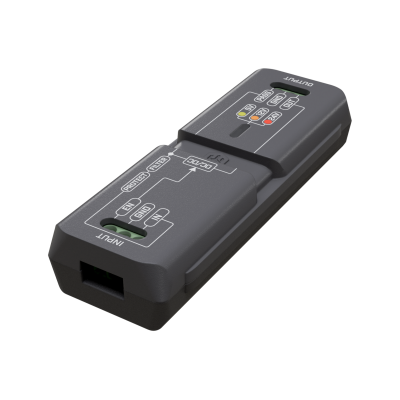


MikroTik APA-1 Automotive Power Adapter Overvoltage
The MikroTik APA-1 is an automotive-grade DC power protection adapter — multi-layer overvoltage protection combining a gas-discharge tube, TVS (transient voltage suppressor) semiconductor, active polarity protection, low-pass filter, and standard fuse in a single inline adapter for MikroTik LtAP and other DC-powered devices installed in vehicle environments. Jumper-selectable output voltage with pass-through mode option. 100W max power consumption, passive cooling, IP20, -40°C to +85°C, MTBF ~100,000 hours at 25°C. CE, E-MARK, EAC, RoHS certified.

We only offer IC Certified products. For international products, contact us.

Ship Charge Will Display As Free Until Ship Address / Location Is Provided To Calculate Ship Charge.
The MikroTik APA-1 is a purpose-built automotive power protection adapter for MikroTik devices installed in vehicles — specifically engineered for the electrical environment of a vehicle's 12V or 24V DC power system, which is fundamentally different from, and more hostile than, a regulated DC bench power supply or a PoE-sourced power feed.
A vehicle's electrical system is not a clean, regulated DC supply. It is a shared bus driven by a lead-acid or lithium battery and an alternator, shared with high-current loads — starter motor, HVAC compressor, headlights, heated seats, windshield defrost — each of which creates voltage transients when switched on or off. The specific failure scenarios that destroy DC-powered electronic devices in vehicle deployments are well-documented:
- **Jump-starting:** A failed battery requires jump-starting from a booster pack or another vehicle. During jump-starting, the vehicle's 12V bus can spike to 24V or above for short durations — double the nominal operating voltage of any 12V-rated device on the bus. A device without transient protection connected to the 12V bus during a jump-start event receives that spike directly.
- **Load dump:** When the alternator's load is suddenly disconnected — for example, when the battery connection is broken while the alternator is generating — the alternator's unloaded output voltage spikes dramatically, sometimes to 60–120V on a nominally 12V system, for a duration of hundreds of milliseconds. Load dump is one of the most destructive automotive transient events for connected electronics.
- **Inductive switching spikes:** Every inductive load on the vehicle bus — the HVAC compressor clutch, the radiator fan motor, the fuel pump — generates a negative voltage spike on the bus when its current is interrupted. These negative spikes can damage devices not protected against reverse voltage excursions below ground.
- **Alternator ripple and conducted EMI:** The alternator's rectified AC output contains ripple voltage superimposed on the DC bus — high-frequency conducted electromagnetic interference that can disrupt sensitive electronics without causing immediate hardware damage but degrades reliability over time.
- **Reverse polarity connection:** In a field installation or roadside repair scenario, DC power connectors can be connected in reverse — positive to negative, negative to positive. Without polarity protection, reverse connection destroys a device instantly.
The APA-1 addresses all five of these failure modes through its multi-layer protection architecture:
**Layer 1 — Gas-discharge tube (GDT):** The GDT is the first line of defence against extreme high-voltage transients — load dump events and severe jump-start spikes. Under normal operating conditions, the gas inside the sealed glass tube is non-conductive and the GDT is electrically invisible. When a high-voltage transient exceeds the GDT's breakdown voltage threshold, the gas ionises instantly, creating a low-resistance path that shunts the transient energy to ground rather than allowing it to reach the downstream device. GDTs are designed for high-energy transient absorption — they handle the large energy content of load dump events that would overwhelm semiconductor-only protection circuits.
**Layer 2 — TVS (transient voltage suppressor) semiconductor:** The TVS diode provides fast-acting clamping for lower-energy, faster transients that the GDT's ionisation time cannot catch — inductive switching spikes, alternator ripple peaks, and short-duration voltage excursions. The TVS clamps the output voltage to a defined level, absorbing the transient energy in the semiconductor junction and preventing it from reaching the downstream device. The combination of GDT (high-energy, slower response) and TVS (lower-energy, faster response) covers the full spectrum of automotive transient types.
**Layer 3 — Active polarity protection:** A MOSFET-based active polarity protection circuit — not a simple diode (which would waste power as heat at every operating moment), but an active circuit that presents near-zero resistance during correct-polarity operation and instantly blocks current during reverse-polarity connection. The result: zero voltage drop and zero power waste under normal operation, and instant protection against reverse connection without a fuse blow or device damage.
**Layer 4 — Low-pass filter:** A passive LC or RC low-pass filter that attenuates high-frequency conducted EMI and alternator ripple on the input, delivering a cleaner DC supply to the downstream device. For RouterBOARD devices with sensitive RF receivers — the LtAP's LTE modem, cellular antenna, or GPS receiver — conducted EMI on the power supply line degrades receiver sensitivity. The APA-1's filter reduces that degradation at the power input stage.
**Layer 5 — Standard fuse:** Overcurrent protection — the fuse opens the circuit when current draw exceeds the fuse rating, protecting both the APA-1 and the connected device from overcurrent faults. The fuse is the final protection layer and the one visible indicator of a protection event — a blown fuse signals that a fault event occurred and the protection circuit absorbed it.
The jumper-selectable output voltage allows the APA-1 to regulate its DC output to a voltage appropriate for the connected MikroTik device, regardless of the vehicle bus voltage. For a 24V commercial vehicle (truck, bus, heavy equipment) where the nominal bus voltage is 24V but the MikroTik LtAP requires 12V or 18–28V input, the jumper selects the correct regulated output voltage. The pass-through mode bypasses output voltage regulation — input voltage is passed directly to the output — for deployments where the vehicle bus voltage is already within the MikroTik device's accepted input range and no voltage conversion is required. The pass-through mode reduces power dissipation in the APA-1 and is the correct mode for standard 12V vehicle deployments powering devices with a wide DC input range.
The E-MARK certification is the distinguishing certification on the APA-1's approval list — and the most important one for automotive deployments. E-MARK (also written as e-mark or ECE mark) is the European automotive component approval standard for electronic devices installed in vehicles. E-MARK certification confirms that the APA-1 has been tested and approved as an automotive-grade component meeting the electromagnetic compatibility (EMC) and safety requirements for vehicle-installed electronics under United Nations Economic Commission for Europe (UNECE) regulations. No other device in this product batch carries E-MARK certification — it is specific to automotive-environment devices. For a fleet operator or automotive integrator procuring MikroTik LtAP devices for permanent vehicle installation, the APA-1's E-MARK certification is a procurement specification requirement in regulated markets.
**Primary use case — LtAP vehicle deployment:** The APA-1 is the standard recommended power protection accessory for any MikroTik LtAP (LtAP LTE kit, LtAP mini LTE kit, LtAP 4G kit) installed in a vehicle — fleet tracking, public transit Wi-Fi, emergency vehicle communications, construction equipment monitoring, agricultural machinery monitoring, or any mobile vehicle deployment. Cross-list the APA-1 on every LtAP product page with the explicit recommendation: "For vehicle installations, power your LtAP through the APA-1 automotive power adapter to protect against vehicle electrical transients."
**Canadian market note:** Certifications are CE, E-MARK, EAC, and RoHS. No FCC or IC wireless certification — the APA-1 is a passive power protection adapter with no wireless transmitter or receiver. No ISED wireless certification advisory applies. The E-MARK certification is a European automotive standard — confirm any Canadian Transport Canada or CSA electrical safety certification requirements with your distributor before listing for Canadian fleet customers.
Key specifications:
- **Product code:** APA-1
- **Function:** Automotive DC power protection adapter (multi-layer)
- **Protection layers:** Gas-discharge tube, TVS semiconductor, active polarity protection, low-pass filter, standard fuse
- **DC inputs:** 1
- **Max power consumption:** 100W
- **Output voltage:** Jumper-selectable (confirm available output voltage options from brochure) + pass-through mode
- **Cooling:** Passive
- **IP rating:** IP20
- **Operating temperature:** -40°C to +85°C
- **MTBF:** ~100,000 hours at 25°C
- **Certifications:** CE, E-MARK, EAC, RoHS — no FCC, no IC
Note: Confirm specific jumper-selectable output voltage options and input voltage range from the APA-1 brochure before listing. Pass-through mode available — confirm pass-through input voltage range from brochure. Compatible with LtAP, LtAP mini, LtAP LTE kit, and other MikroTik RouterBOARD devices — confirm full compatibility list from MikroTik documentation.

- Product code
- APA-1
- Max Power consumption
- 49 W
- Tested ambient temperature
- -40°C to 85°C
- Number of DC inputs
- 1
- Cooling type
- Passive
- Certification
- CE, E-MARK, EAC, ROHS