
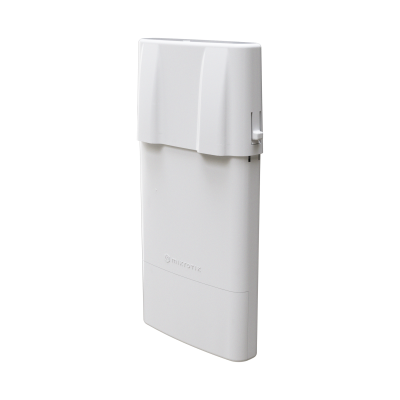


MikroTik NetBox 5 ax Wi-Fi 6 AX3000 Outdoor AP ROS
The MikroTik NetBox 5 ax (L22UGS-5HaxD-5-8HpND) is a dual-radio outdoor wireless device — 5 GHz 802.11ax Wi-Fi 6 2-chain 2,400 Mbps main radio (QCN-6102) + 2.4 GHz 802.11b/g/n 2-chain 300 Mbps management/bridge radio (QCA9887), IPQ-5010 dual-core ARM32 at 800 MHz, 256 MB RAM, 128 MB NAND, RouterOS v7 License 4, 1× Gigabit Ethernet with passive PoE-in (18–28V), 1× SFP (2.5G supported), 1× USB 2.0 Type-A (max 1.5A), built-in 8 dBi dual-polarisation patch antennas, passive cooling, IP55, -40°C to +70°C, MTBF ~200,000 hours at 25°C. CE, FCC, IC, EAC, RoHS certified. Includes 24V 1.2A power adapter, Gigabit PoE injector, K-41 fastening set, quickMOUNT pro.

We only offer IC Certified products. For international products, contact us.

Ship Charge Will Display As Free Until Ship Address / Location Is Provided To Calculate Ship Charge.
The MikroTik NetBox 5 ax is a compact outdoor wireless device built on a dual-radio architecture — a primary 5 GHz Wi-Fi 6 radio for main data connectivity and a secondary 2.4 GHz radio for management access, out-of-band bridging, or independent secondary wireless link — in a weather-sealed outdoor enclosure with built-in patch antennas, 2.5G SFP fiber uplink, and USB LTE failover capability.
The dual-radio architecture separates two distinct functions into independent radios:
**Primary radio — 5 GHz Wi-Fi 6 (802.11a/n/ac/ax, QCN-6102, 2-chain, 2,400 Mbps max):** The primary data connectivity radio. This is a full 802.11ax Wi-Fi 6 radio with OFDMA, MU-MIMO, WPA3, and BSS colouring — the radio used for the main wireless link in any PtP or PtMP deployment. In a fixed wireless access deployment, the 5 GHz radio is the subscriber-facing link between the NetBox 5 ax CPE unit at the subscriber premises and the sector base station at the tower or rooftop. In a point-to-point bridge deployment, the 5 GHz radio is the bridge link between two locations. CAPsMAN integration allows the 5 GHz radio to operate as a managed CAP in a RouterOS CAPsMAN-controlled deployment, receiving configuration centrally.
**Secondary radio — 2.4 GHz Wi-Fi 4 (802.11b/g/n, QCA9887, 2-chain, 300 Mbps max):** The secondary radio dedicated to management access and out-of-band connectivity. For a NetBox 5 ax installed at a remote subscriber premises or rooftop bridge location, the 2.4 GHz radio provides independent management access — a technician with a 2.4 GHz Wi-Fi device can connect to the management SSID on the 2.4 GHz radio to configure, monitor, or troubleshoot the device even when the primary 5 GHz link is down. This is operationally significant: if the 5 GHz link fails, the 2.4 GHz management radio remains accessible independently, allowing remote diagnosis without a physical site visit. The 2.4 GHz radio can alternatively be configured as a local Wi-Fi access point for a subscriber's indoor devices — providing Wi-Fi 4 indoor coverage from the outdoor CPE without a separate indoor AP, though this is limited to 2.4 GHz 300 Mbps.
The built-in 8 dBi dual-polarisation patch antennas are integrated into the NetBox 5 ax enclosure — both the 5 GHz and 2.4 GHz radios use the built-in patch antennas rather than external connectors. Dual-polarisation (horizontal and vertical, or ±45° slant) on the 5 GHz patch antenna enables 2-chain MIMO operation with spatial stream separation — a critical antenna architecture for 802.11ax MIMO throughput. 8 dBi at 5 GHz provides directional gain in the forward hemisphere of the patch antenna, focusing transmit power toward the intended link direction rather than radiating omnidirectionally. For a subscriber CPE unit mounted on the exterior of a house pointed at a tower 3–10 km away, 8 dBi directional gain contributes meaningfully to the link budget versus a standard dipole or omnidirectional antenna.
The 2.5G SFP port is the wired uplink differentiator — a fibre SFP transceiver connected to a 2.5G-capable upstream switch provides 2.5 Gbps wired backhaul capacity, significantly exceeding the Gigabit Ethernet uplink available on compact outdoor APs without an SFP port. For a NetBox 5 ax installed at a rooftop or tower aggregation point — receiving Wi-Fi 6 traffic from multiple downstream CPE units or client devices and forwarding it over a fiber uplink — the 2.5G SFP port ensures the wired backhaul is not the throughput bottleneck. Compatible SFP transceivers for the NetBox 5 ax's SFP port include the MikroTik XS+85LC01D (1G/10G/25G tri-rate multimode 850nm) at 1G operation and standard 1G SFP transceivers — confirm 2.5G-compatible SFP transceiver support from the NetBox 5 ax's wired interface compatibility documentation.
The Gigabit Ethernet port provides passive PoE-in at 18–28V — not 802.3af/at active PoE. This is the same passive PoE requirement as the mANTBox ax 15s and must be stated explicitly on the product page: "The NetBox 5 ax requires passive PoE 18–28V on Ether1 — not 802.3af/at active PoE. Use the included Gigabit PoE injector or a dedicated passive PoE source at 18–28V. The DC jack accepts 12–28V direct DC input." A standard 802.3af/at PoE switch delivering 44–57V active PoE will not power the NetBox 5 ax correctly without a passive PoE injector.
The USB 2.0 Type-A port (max 1.5A) enables the same USB LTE modem WAN failover capability as the mANTBox ax 15s and L11UG-5HaxD. For a remote fixed wireless subscriber location where the primary connectivity is the 5 GHz Wi-Fi 6 link to the tower, a USB LTE modem provides automatic WAN failover if the wireless link becomes unavailable. RouterOS failover scripting detects primary link failure and redirects traffic to the cellular modem without manual intervention — maintaining internet connectivity during wireless link outages. The 1.5A USB current rating supports high-current USB LTE modems. Confirm USB LTE modem compatibility against the MikroTik USB modem compatibility list for Rogers, Bell, and TELUS network modems for Canadian deployments.
RouterOS v7 License 4 on the NetBox 5 ax provides the full routing, firewall, VPN, and scripting feature set. For an ISP deploying the NetBox 5 ax as a subscriber CPE unit, RouterOS's PPPoE client, DHCP client, NAT, and firewall capabilities allow the CPE to operate as a subscriber-premises router — handling IP address assignment, NAT, and firewall for the subscriber's local network from the outdoor CPE unit without a separate indoor router. WireGuard VPN allows the operator to establish an encrypted management tunnel from each CPE unit back to the central RouterOS management infrastructure over the subscriber's wireless link.
The quickMOUNT pro included in the package provides ±70° azimuth and elevation adjustment from a fixed wall or pole mount — the same precision mounting hardware as the mANTBox ax 15s. For a subscriber CPE installation where precise beam alignment to the tower base station is required for link quality, the quickMOUNT pro's graduated scale allows documented, repeatable alignment settings.
The IP55 weatherproofing and -40°C to +70°C operating temperature make the NetBox 5 ax suitable for permanent outdoor deployment across all Canadian climate zones. Passive cooling and no moving parts support long-term unattended outdoor deployment without maintenance. The MTBF of ~200,000 hours at 25°C is one of the highest in this product batch — reflecting the passive cooling architecture and mature hardware platform.
**5-year software support guarantee:** RouterOS v7 updates free for life of product or minimum 5 years from date of purchase.
**Canadian market note — IC certification confirmed:** The NetBox 5 ax is certified CE, FCC, IC, EAC, and RoHS — IC (ISED) certification is confirmed and published on the product page. The NetBox 5 ax can be listed and sold for Canadian outdoor wireless operation without an IC certification advisory. Confirm the specific IC certification number from the regulatory documentation linked on the product page for listing purposes. This is an important selling point for Canadian ISP and enterprise customers who require IC-certified CPE equipment for ISED compliance.
Key specifications:
- **Product code:** L22UGS-5HaxD-5-8HpND
- **Architecture:** ARM 32-bit
- **CPU:** IPQ-5010, dual-core ARM32, 800 MHz
- **RAM:** 256 MB
- **Storage:** 128 MB NAND
- **OS:** RouterOS v7, License 4
- **Wi-Fi 5 GHz:** 802.11a/n/ac/ax, Wi-Fi 6, 2-chain, 2,400 Mbps max, QCN-6102, 8 dBi built-in dual-pol patch antenna
- **Wi-Fi 2.4 GHz:** 802.11b/g/n, Wi-Fi 4, 2-chain, 300 Mbps max, QCA9887, 8 dBi built-in patch antenna
- **Wi-Fi security:** WPA3-PSK, WPA3-EAP, OWE, MFP
- **Ethernet:** 1× 10/100/1000 Mbps, passive PoE-in (18–28V)
- **SFP port:** 1× (2.5G supported)
- **USB:** 1× USB 2.0 Type-A, max 1.5A, USB Power Reset
- **DC jack input:** 12–28V
- **Max power consumption:** 21W
- **Max power without attachments:** 11W
- **Cooling:** Passive
- **IP rating:** IP55
- **Operating temperature:** -40°C to +70°C
- **MTBF:** ~200,000 hours at 25°C
- **Monitors:** PCB temperature, voltage, beeper
- **Certifications:** CE, FCC, IC, EAC, RoHS — IC confirmed
- **Included:** 24V 1.2A power adapter, Gigabit PoE injector, K-41 fastening set, quickMOUNT pro
- **Suggested price:** USD 159.00

- Product code
- L11UG-5HaxD-NB
- Architecture
- ARM
- CPU
- IPQ-5010
- CPU core count
- 2
- CPU nominal frequency
- 800 MHz
- Operating System
- RouterOS v7
- Size of RAM
- 256 MB
- Storage size
- 128 MB
- Storage type
- NAND
- Tested ambient temperature
- -40°C to 70°C
- Number of DC inputs
- 1 (PoE-IN)
- Max Power consumption
- 15 W
- Max power consumption without attachments
- 6 W
- Cooling type
- Passive
- PoE in
- Passive PoE
- PoE in input Voltage
- 18-28 V
- 10/100/1000 Ethernet ports
- 1
- Number of USB ports
- 1
- USB Power Reset
- Yes
- USB slot type
- USB type A
- Max USB current (A)
- 1.5
- Voltage Monitor
- Yes
- PCB temperature monitor
- Yes
- Wireless 5 GHz number of chains
- 2
- Wireless 5 GHz standards
- 802.11a/n/ac/ax
- Wireless 5 GHz chip model
- QCN-6102
- Wi-Fi generation
- Wi-Fi 6
- Wireless 5 GHz Max data rate
- 2400 Mbit/s
- Certification
- CE, FCC, IC, EAC, ROHS
- IP
- 54