
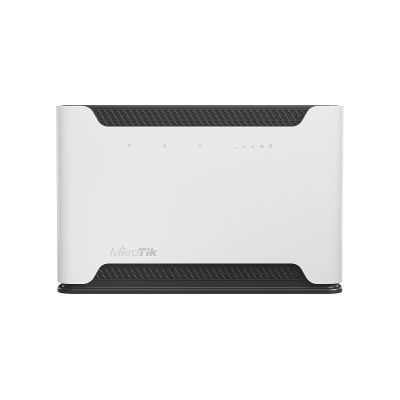


MikroTik Chateau LTE12 2025 LTE Cat12 Wi-Fi Router
The MikroTik Chateau LTE12 (2025) (D53G-5HacD2HnD-TC&EG120K-EA) is the 2025 refresh of MikroTik's most accessible LTE home and office router — now with a new Quectel EG120K modem delivering expanded 4×4 MIMO across more LTE bands (B1/3/7/38/40/41), full Band 28 (700 MHz) support for rural low-band coverage, LTE Cat 12 at 600 Mbps downlink, dual-band Wi-Fi (300 Mbps on 2.4 GHz Wi-Fi 4 + 867 Mbps on 5 GHz Wi-Fi 5), 5× Gigabit Ethernet, SMA female connectors for external LTE antennas, 1× Micro SIM slot, USB Type-A with USB Power Reset, and RouterOS v7 License Level 4. The right Chateau for households and small businesses that need solid LTE internet and full RouterOS control, without paying for 5G they cannot use yet.

We only offer IC Certified products. For international products, contact us.

Ship Charge Will Display As Free Until Ship Address / Location Is Provided To Calculate Ship Charge.
The MikroTik Chateau LTE12 (2025) is the practical choice in the Chateau lineup — the router for the household on a Bell or Rogers LTE plan, the small business using a Telus LTE SIM for backup internet, or the remote property where LTE is the only available connection and 5G is not yet in range. It delivers LTE Cat 12 performance with a proper RouterOS v7 platform underneath — not a carrier-locked firmware with a web interface that expires when your plan changes.
The 2025 modem upgrade is meaningful. The new Quectel EG120K brings 4×4 MIMO to a wider set of LTE bands — including B1 (2100 MHz), B3 (1800 MHz), B7 (2600 MHz), B38, B40, and B41 TDD bands. 4×4 MIMO on more bands means the Chateau LTE12 (2025) can pull more spatial streams simultaneously on the bands your carrier is actually transmitting, rather than falling back to 2×2 when it hits a band the previous modem did not support at full MIMO. In dense urban areas and suburban markets where carriers use multiple bands simultaneously via carrier aggregation, this translates directly to more consistent peak speeds and fewer throughput drops when the serving band changes.
Band 28 (700 MHz) support is the rural coverage story. Bell and Telus use 700 MHz extensively for their rural and semi-rural LTE coverage in Canada — it travels further, penetrates buildings more effectively, and reaches areas where higher-frequency bands simply cannot. The Chateau LTE12 (2025) includes Band 28 in both FDD LTE and 3G fallback, ensuring it works on the same rural tower frequencies that the operator has invested in for exactly this type of deployment.
The SMA female connectors for external LTE antennas are the signal quality upgrade path. In locations with weak indoor signal — basements, rural properties with distant towers, buildings with heavy wall construction — connecting a directional or high-gain external LTE antenna via the SMA ports often makes the difference between a marginal, inconsistent connection and a solid, reliable link. No other router in this price range provides a cleaner upgrade path for challenging signal environments.
RouterOS v7 License Level 4 is the same platform used by ISPs and network engineers globally. Full VLAN support, advanced firewall rules, traffic shaping, VPN (WireGuard, OpenVPN, IPsec, L2TP), BGP, OSPF, SNMP, and scripting are all included — no locked features, no subscriptions, no firmware expiry. For households that want a proper router under the hood, and for small businesses that need real network control at home-router pricing, this is the value proposition.
The dual-band Wi-Fi covers the everyday device connectivity side. 5 GHz Wi-Fi 5 at 867 Mbps handles laptops, smart TVs, and gaming consoles with low-latency throughput. 2.4 GHz Wi-Fi 4 at 300 Mbps covers IoT devices, smart home gear, and anything that needs range over speed. Five Gigabit Ethernet ports connect wired devices directly — NAS, desktop PCs, switches, IP cameras — with full port assignment flexibility under RouterOS.
When 5G becomes available at your location or your deployment requires 2 Gbps+ downlink, the direct upgrade path within the Chateau family is the Chateau 5G R17 ax — same brand, same RouterOS platform, 5G R17 modem with Wi-Fi 6 and eSIM. The Chateau LTE12 (2025) is the right choice now; the upgrade path is clear when the time comes.
Key features:
- LTE Cat 12 — Quectel EG120K modem, 600 Mbps DL / 150 Mbps UL, carrier aggregation
- Expanded 4×4 MIMO — now covers B1/3/7/38/40/41 for stronger multi-band performance
- Full Band 28 (700 MHz) support — Bell and Telus rural LTE coverage frequency
- New B32 (1500 MHz SDL) support — supplemental downlink carrier aggregation
- LTE FDD bands: B1/3/5/7/8/20/28/32
- LTE TDD bands: B38/40/41
- 3G R8: B1/3/5/8 (42.2 Mbps DL / 5.76 Mbps UL)
- SMA female connectors — external LTE antenna support for weak-signal environments
- 1× Micro SIM slot
- Dual-band Wi-Fi — 2.4 GHz 802.11b/g/n (300 Mbps, 2 chains, 2 dBi, Wi-Fi 4); 5 GHz 802.11a/n/ac (867 Mbps, 2 chains, 4 dBi, Wi-Fi 5); both on IPQ-4019 chip
- 5× 10/100/1000 Mbps Gigabit Ethernet — full port assignment flexibility
- Quad-core IPQ-4019 ARM 32-bit CPU, 448–896 MHz (auto), 256 MB RAM, 32 MB FLASH
- 1× USB Type-A port (1A, USB Power Reset) — storage, configuration backups, USB tethering
- DC jack power input 12–28V, max 24W (18W without attachments)
- Passive cooling, -20°C to +70°C
- Mode button
- RouterOS v7, License Level 4 — VLANs, firewall, VPN, BGP, OSPF, traffic shaping, SNMP, scripting — no subscriptions, no locked features, free updates for life (minimum 5 years)
- iOS and Android app for simplified setup
- Certified CE, EAC, RoHS | IP20
- MTBF ~200,000 hours at 25°C
In the box: 24V 1.2A power adapter, UTP Flat Cable (1.5m).
Ideal for: Canadian households on Bell, Rogers, or Telus LTE plans replacing their carrier-issued router with a proper RouterOS platform; small businesses using LTE as primary or backup internet; rural and semi-rural properties on Band 28 (700 MHz) LTE coverage needing Band 28-capable hardware; remote workers requiring full VPN and firewall control on a mobile data connection; anyone in a weak-signal location who needs SMA antenna ports for an external directional LTE antenna; and buyers who need solid LTE router capability and are not yet in a 5G coverage area.

- Product code
- D53G-5HacD2HnD-TC&EG120K-EA
- CPU
- Quad-Core IPQ-4019 448-896 MHz (auto)
- CPU architecture
- ARM 32bit
- Dimensions
- 240 x 156 x 44 mm
- Operating Temperature
- -20°C to +70°C
- Size of RAM
- 256 MB
- RAM type
- DDR3L
- Storage type
- 32 MB, Flash
- Number of 1G Ethernet ports
- 5
- Antenna gain dBi for 2.4 GHz
- 2.4 GHz - 2 dBi, 5 GHz - 4 dBi
- MIMO DL
- 4x4
- MIMO UL
- 1x1
- Operating System
- RouterOS v7, License level 4
- Power adapter nominal voltage
- 24 V
- Power adapter nominal current
- 1.2 A
- Max Power consumption
- 24 W
- Switch chip model
- IPQ-4019
- LTE modem
- EG120K-EA
- TAC
- 86056104
- Wireless Standards
- 2.4 GHz 802.11b/g/n dual-chain, 5 GHz 802.11a/n/ac dual-chain
- Number of DC inputs
- 1
- DC jack input Voltage
- 12-28 V
- Max power consumption without attachments
- 18 W
- 3G Category
- R8 (42.2Mbps Downlink, 5.76Mbps Uplink)
- 3G bands
- 1 (2100MHz) / 3 (1800MHz) / 5 (850MHz) / 8 (900MHz)
- USB slot type
- 1 (2.0 type A)
- LTE Category
- 12 (600Mbps Downlink, 150Mbps Uplink)
- LTE FDD bands
- 1 (2100MHz) / 3 (1800MHz) / 5 (850MHz) / 7 (2600MHz) / 8 (900 MHz) / 20 (800MHz) / 28 (700MHz) / 32 (1500 MHz)
- LTE TDD bands
- 38 (2600MHz) / 40 (2300MHz) / 41 (2500MHz)
- Wireless interface model
- IPQ-4019 (2.4 GHz), IPQ-4019 (5 GHz)