
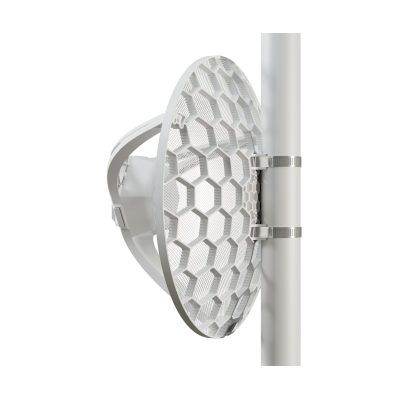


MikroTik LHG LTE18 Kit CAT18 Last-Mile LTE Router 17 dBi
The MikroTik LHG LTE18 kit is a CAT18 LTE outdoor router with a built-in 17 dBi high-gain grid antenna — delivering download speeds up to 1.2 Gbps and uploads up to 150 Mbps via carrier aggregation, from locations where standard routers and phones have no usable signal. Powered by 802.3af/at PoE-in (12–57V), running RouterOS v7 on a dual-core 64-bit ARM CPU at 800 MHz with 256 MB RAM, IP54-rated, and rated from -40°C to +70°C. Includes Gigabit PoE injector, 24V adapter, hose clamps, and screw kit. The correct last-mile LTE solution for remote sites, rural properties, and any location where cable or fibre infrastructure is absent.

We only offer IC Certified products. For international products, contact us.

Ship Charge Will Display As Free Until Ship Address / Location Is Provided To Calculate Ship Charge.
The MikroTik LHG LTE18 kit is purpose-built for one scenario: getting fast, reliable internet to a location where the existing infrastructure — cable, fibre, fixed wireless — does not reach, and where standard LTE routers cannot pull a usable signal from a distant cell tower. The 17 dBi high-gain grid antenna is the solution to the signal problem. Standard indoor LTE routers use internal antennas with 2–4 dBi of gain. The LHG LTE18's 17 dBi directional grid antenna provides a 13–15 dB improvement in effective received signal — the difference between a marginal, unusable signal and a stable, high-throughput LTE connection at the same location. For remote properties, rural businesses, agricultural operations, and off-grid sites across Canada, this antenna gain advantage is the reason the LHG LTE18 works when everything else does not.
The Category 18 LTE modem is what separates the LHG LTE18 from previous LHG LTE generations. CAT18 supports download speeds up to 1.2 Gbps and upload speeds up to 150 Mbps — and critically, it supports carrier aggregation across multiple LTE bands simultaneously. Carrier aggregation is not just a peak speed feature. In rural areas where a single LTE band may be congested or weak, the ability to aggregate two or more bands simultaneously delivers measurably better throughput and lower latency even at the cell edge. MikroTik's own observation: internet speeds doubling in rural areas after switching to carrier aggregation. For a remote site sharing a crowded rural tower with many other users, the CAT18 modem's carrier aggregation capability provides a practical, measurable advantage over single-band CAT6 or CAT12 devices.
The supported LTE FDD bands — 1 (2100 MHz), 3 (1800 MHz), 5 (850 MHz), 7 (2600 MHz), 8 (900 MHz), 20 (800 MHz), and 28 (700 MHz) — cover the primary LTE frequency deployments used by Canadian carriers. Band 4 (AWS 1700/2100 MHz) is notably absent from the published FDD band list — confirm Band 4 support with your MikroTik distributor before recommending to Canadian buyers, as Band 4 is a primary carrier band for Bell, Rogers, and Telus in urban and suburban Canada. Band 28 (700 MHz) and Band 5 (850 MHz) cover the low-band rural LTE deployments used for extended coverage in remote Canadian locations — these are the bands most relevant to the LHG LTE18's core use case. LTE TDD bands 38 (2600 MHz), 40 (2300 MHz), and 41 (2500 MHz) extend coverage to markets using TDD-LTE spectrum.
The 3G fallback covers UMTS/HSPA+ at Category R8 (42.2 Mbps downlink, 11.2 Mbps uplink) across bands 1, 3, 5, and 8 — providing connectivity continuity at sites where LTE signal is temporarily unavailable.
The grid antenna design solves two outdoor deployment problems simultaneously. The open grid structure dramatically reduces wind loading compared to a solid dish or panel — the LHG LTE18 can be pole or mast-mounted in high-wind Canadian conditions without the structural stress that a solid reflector would impose. The massive integrated heatsink handles the thermal demands of continuous outdoor operation under direct sun and varying temperatures without a fan or moving parts — passive cooling only, from -40°C to +70°C.
Power is delivered via 802.3af/at PoE-in (12–57V) on the single Gigabit Ethernet port — a single Ethernet cable from the included Gigabit PoE injector carries both power and data to the LHG LTE18 on the mast, with no separate power run to the mounting point. The 24V 0.8A power adapter and Gigabit PoE injector are both included — the LHG LTE18 is fully powered and ready to deploy out of the box. Maximum power consumption is 8W.
At the core is a dual-core ARM64 CPU (88F3720, 800 MHz) with 256 MB RAM running RouterOS v7 on License 3 — full RouterOS scripting, firewall, QoS, VPN, and traffic management on the gateway device itself, not just a modem bridge. For remote sites where the LHG LTE18 is both the LTE uplink and the local network router, RouterOS v7 provides enterprise-grade network management without a separate router device. Software updates are included for the life of the product, guaranteed minimum 5 years from purchase.
The M.2 slot provides expansion capability — the published spec confirms one M.2 slot, enabling modem or storage upgrades. Confirm M.2 slot type, keying (B-key, M-key), and supported M.2 module options from the product brochure or your MikroTik distributor before recommending M.2 expansion to buyers.
Installation hardware is fully included: 2× hose clamps for pole/mast mounting, K-LHG screw kit, Gigabit PoE injector, and 24V 0.8A power adapter. The LHG LTE18 arrives ready to mount on a standard mast or pole — no additional hardware purchase required for basic installation.
Key specifications:
- **LTE modem:** CAT18 — 1.2 Gbps downlink, 150 Mbps uplink, carrier aggregation, 2×2 DL MIMO
- **LTE FDD bands:** 1 (2100 MHz), 3 (1800 MHz), 5 (850 MHz), 7 (2600 MHz), 8 (900 MHz), 20 (800 MHz), 28 (700 MHz)
- **LTE TDD bands:** 38 (2600 MHz), 40 (2300 MHz), 41 (2500 MHz)
- **3G:** Category R8 — 42.2 Mbps DL / 11.2 Mbps UL — bands 1, 3, 5, 8
- **Antenna:** 17 dBi high-gain grid, integrated, directional — up to 2.7 GHz
- **SIM:** 1× Micro SIM slot (SIM not included)
- **M.2 slot:** 1× (confirm keying and supported modules from brochure)
- **Ethernet:** 1× 10/100/1000 Mbps, PoE-in
- **PoE-in:** 802.3af/at, 12–57V input
- **Max power consumption:** 8W
- **Cooling:** Passive — massive integrated heatsink, no fan
- **CPU:** 88F3720, dual-core ARM64, 800 MHz
- **RAM:** 256 MB
- **Storage:** 16 MB FLASH
- **OS:** RouterOS v7, License 3
- **IP rating:** IP54
- **Operating temperature:** -40°C to +70°C
- **MTBF:** ~200,000 hours at 25°C
- **Certifications:** CE, EAC, RoHS — no FCC, no IC published
- **Included:** 24V 0.8A power adapter, Gigabit PoE injector, 2× hose clamps, K-LHG screw kit
- **Product code:** LHGGM&EG18-EA
Note: SIM card not included — LTE connectivity requires a Micro SIM from a compatible carrier. Confirm LTE band compatibility with your Canadian carrier before purchase. Band 4 (AWS) absence from the published FDD band list should be confirmed with your distributor for Canadian carrier compatibility.

- Product code
- LHGGM&EG18-EA
- CPU
- 88F3720
- CPU core count
- 2
- CPU nominal frequency
- 800 MHz
- Architecture
- ARM 64bit
- Size of RAM
- 256 MB
- Storage size
- 16 MB
- Storage type
- FLASH
- MIMO DL
- 2x2
- Operating System
- RouterOS v7
- RouterOS License
- 3
- Max Power consumption
- 8W
- TAC
- 86981604
- MTBF
- Approximately 200'000 hours at 25C
- Tested ambient temperature
- -40°C to 70°C
- Number of DC inputs
- 1 (PoE-IN)
- Max power consumption without attachments
- 8W
- Cooling type
- Passive
- PoE in
- 802.3af/at
- PoE in input Voltage
- 12-57 V
- 3G Category
- R8 (42.2Mbps Downlink, 11.2Mbps Uplink)
- 3G bands
- 1 (2100MHz) / 3 (1800MHz) / 5 (850MHz) / 8 (900MHz)
- 10/100/1000 Ethernet ports
- 1
- M.2 slots
- 1
- Number of SIM slots
- 1 Modem (Micro SIM)
- LTE Category
- 18 (1.2Gbps Downlink, 150Mbps Uplink)
- LTE FDD bands
- 1 (2100MHz) / 3 (1800MHz) / 5 (850MHz) / 7 (2600MHz) / 8 (900 MHz) / 20 (800MHz) / 28 (700MHz)
- LTE TDD bands
- 38 (2600MHz) / 40 (2300MHz) / 41 (2500MHz)
- Certification
- CE, EAC, ROHS
- Mode button
- Yes
- IP
- 54


